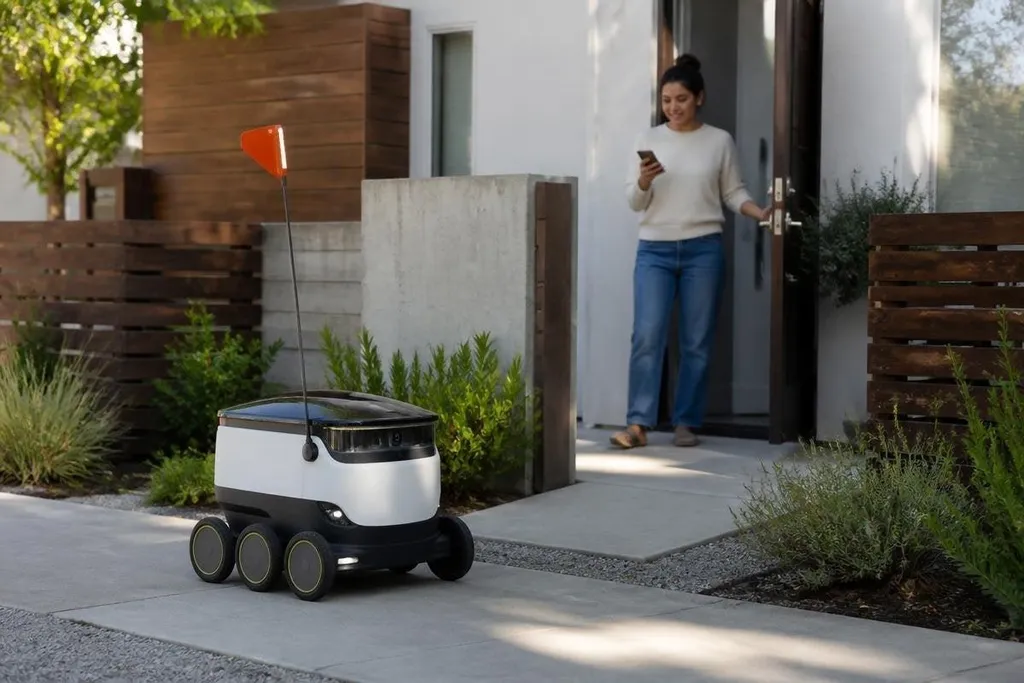
The final trip from a local hub to a customer’s door is often the hardest part of delivery. Last-mile robots are being built for that short route, where traffic, entrances, pedestrians, and missed handoffs can decide the cost of the whole order.
- Last-mile work includes the route from a local depot to the delivery address.
- Autonomous mobile robots use cameras, LiDAR, maps, and software to move without constant steering.
- The main test is practical: can a robot finish the handoff safely and reliably?
The last mile has a different problem
Long-distance transport follows fixed routes between known sites. The last mile ends at a changing address, so the robot must deal with driveways, sidewalks, crossings, doors, lifts, and people who may not be waiting outside.
That creates extra stops and extra decisions. A robot that carries one order still needs to find the correct building, avoid a blocked path, and confirm that the package reaches the right person.
The work also happens close to homes and shops. A machine can move at a low speed and still create trouble if it blocks a pavement, misses a curb, or stops where a wheelchair user needs to pass.
How these robots work
Most delivery robots use an autonomous mobile robot, or AMR, design. An AMR combines wheels, motors, cameras, LiDAR, maps, and software that selects a safe route from its current position to the drop-off point.
LiDAR measures distance with pulses of light. Cameras help the robot read visual details, while map data gives it a rough layout of the area. The robot still needs rules for uncertain cases, such as a temporary barrier or a person standing in its path.
A remote operator may also watch several robots and step in when a route needs human judgment. That changes the job rather than removing every human decision. The operator becomes the fallback for cases the robot cannot handle on its own.
The handoff needs its own design. A locked storage compartment can protect an order during travel, but the customer still needs a clear way to open it. The system may use an app, a code, or a local delivery worker, depending on the service.
Why the route matters to automation
A short route can make testing easier because the robot works within a limited area. The same streets, buildings, and crossings appear again, so the software can build a map and the operator can learn the common problem spots.
That does not make the route easy. A delivery robot must deal with weather, poor surfaces, road works, pets, crowds, and buildings without a clear entrance. Each issue can turn a planned trip into a human support task.
A delivery trial needs more than a route that ends at the right address. A report on Robot24 can give you the route, handoff method, test date, and human support used in the trial. Those details show if the robot completed a delivery or only completed a drive.
The value of a last-mile robot depends on the complete trip, including charging, supervision, maintenance, loading, and the time spent fixing failed deliveries. A robot that travels well but needs frequent human help may shift costs rather than cut them.
What remains unproven
Public operation raises questions that a controlled test cannot answer. Can the robot keep moving when a pavement is blocked? Can it stop safely near children and pets? Can a customer recover an order when the robot reaches the wrong entrance?
Battery use also matters. A route may be short, but repeated stops, slopes, heavy loads, and cold weather can change how often the robot needs to charge. The service must plan around that loss of working time.
Local authorities may set different conditions for sidewalk machines, road crossings, speed, storage, and remote supervision. A design accepted in one town may need changes in another.
I'd support last-mile robots where the route is mapped, the handoff is clear, and a human can respond quickly when the robot stops.
A practical buying and trial checklist
Use these checks before treating a delivery robot as ready for regular service:
- Map the route: record crossings, slopes, doors, lifts, and common obstructions.
- Test the handoff: confirm who opens the compartment and how an incorrect delivery gets fixed.
- Count human help: log every remote intervention during a full delivery run.
- Check the load: match the storage space and weight limit to the orders you send.
- Plan charging: set a charging routine that fits the delivery window.
- Set safety rules: define where the robot stops, how it signals people, and who can stop it.
Last-mile robots are becoming more important because the final route exposes the cost of every delay and every handoff. The next useful proof will be simple: repeated deliveries on public routes, with intervention logs and failed handoffs counted rather than hidden.